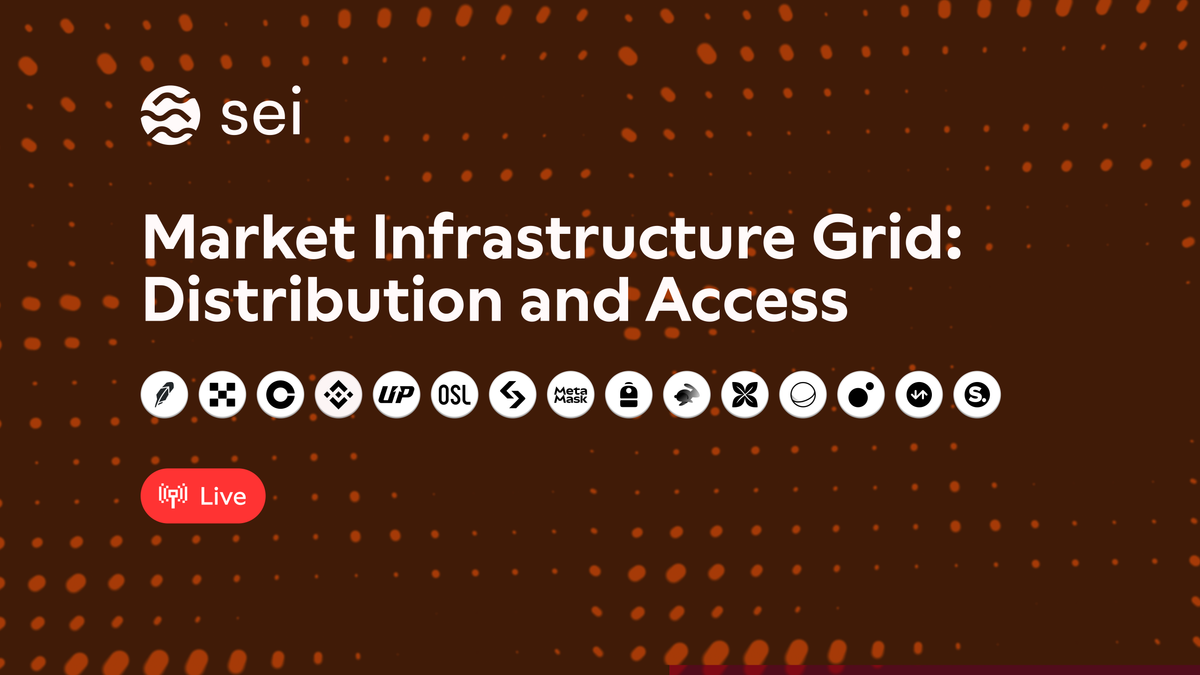
Market Infrastructure Grid: Distribution & Access System
“Having a great idea for a product is important, but having a great idea for product distribution is even more important.” — Reid Hoffman
Distribution is the circulatory system of markets. Without it, even the healthiest asset sits inert. Who can participate, how quickly they can engage, and where capital originates determine whether a market forms at all.
For enterprises and institutions modernizing financial operations, access to users and capital is a core decision variable. Distribution determines whether a deployment reaches relevance, sustains activity, and operates continuously at global scale.
Within the Sei Market Infrastructure Grid, the Distribution & Access System maps how global users and capital enter the Sei ecosystem. Through established exchanges, wallets, and payment platforms, these providers form a unified surface that connects real-time markets on Sei to participants across regions, interfaces, and financial workflows.
For enterprises and institutions, deployment decisions begin with distribution. The Grid makes that distribution legible and actionable.
Global Exchange Gateways
Global exchanges serve as primary access corridors into the Sei ecosystem. For enterprises, they determine where a market can be accessed, who can participate, and how quickly activity forms after launch.
Global Trading Venues
Exchanges like OKX and Bitget together serve over 90 million users across 150+ countries. For enterprises deploying on Sei, this means the on-ramp problem is already solved. Global users already have established pathways to access the network and its liquidity.
United States Access
Coinbase, Robinhood, and Binance.US reach over 130 million users combined. Through these platforms, Sei-based markets connect to regulated institutional and mainstream retail capital in the world’s largest economy.
Asia–Pacific Access
Upbit commands over 80% of South Korea’s crypto market—a country where more than 16 million people hold digital assets and trading volume has, at times, surpassed the local stock market. OSL, Hong Kong’s first licensed crypto exchange, offers SEI exposure to a market with over 5 million active crypto accounts.
Taken together, these exchanges connect Sei to some of the world’s most active digital asset markets. This allows deployments on Sei to launch directly into environments where participation already exists, reducing the gap between deployment and active trading.
Institutional & Consumer On-Ramps
On-ramps define how capital enters onchain markets. For most projects, this is a cold-start problem: teams launch, spend months negotiating integrations, wait on compliance approvals, and dedicate extensive time to coaching users on how to fund wallets. On Sei, that work is already done.
Global & Embedded Fiat Access
MoonPay enables instant fiat-to-crypto connectivity, serving over 30 million users across 160+ countries and is embedded into more than 300 applications, including MetaMask and OpenSea. Transak powers on-ramps for more than 350 web3 applications across 64 countries. Both are live on Sei—meaning a user in Brazil can pay with Pix, a user in the UK can use Faster Payments, and a user in the US can pull directly from their bank account. Day one. No integration lift required.
Enterprise Checkout & Compliance Infrastructure
Simplex, now part of publicly traded Nuvei, provides EU-licensed payment processing with a 100% fraud protection guarantee. For enterprises requiring high-volume, regulated capital entry, this infrastructure is available from day one on Sei.
The crypto industry has long rallied around “disrupt the banks.” But banks aren’t disappearing. The ability to move capital seamlessly between traditional finance and onchain markets may be the most important distribution advantage an ecosystem can offer.
The User Interaction Layer
Wallets and checkout infrastructure define how users interact with markets on Sei. This layer translates Sei’s execution environment into interfaces users already know—or interfaces so simple they don’t realize they’re using a blockchain at all.
EVM-Native Wallet Access & Execution
MetaMask has more than 30 million monthly active users—more than most banks. Backpack includes a regulated exchange built directly into its wallet infrastructure. Rabby offers an experience more intuitive than most fintech applications. Together, these platforms connect deployments on Sei to some of the world’s most established onchain user bases, offering standardized access points that work across applications and workflows.
Abstracted Onboarding & Payments
Platforms like Crossmint and Sphere go further, enabling email login, credit card checkout, and stablecoin settlement without requiring users to manage a wallet at all. Crossmint’s infrastructure already powers enterprises such as Mastercard, Santander, and Red Bull. For teams building on Sei, this means reaching users who would never download a wallet app.
These interfaces make Sei accessible across a wide spectrum of use cases—from self-custodied trading to consumer onboarding where the blockchain is invisible.
The Entry Point for Modern Markets
The Distribution & Access System forms the circulatory system of markets on Sei. Without it, even the best infrastructure sits inert. With it, capital flows, users arrive, and markets come alive.
For enterprises, this changes the deployment equation. Instead of spending months building distribution from scratch, teams launch into an ecosystem where more than 200 million exchange users, over 30 million wallet users, and fiat on-ramps spanning over 160 countries are already in place. The reach exists. The capital pathways are open. The question is no longer whether participation is possible—it’s what you’ll build.
Sei is the infrastructure for modern markets. The Grid is how enterprises plug in.