Market Infrastructure Grid: The Capital System
Onchain markets offer a fundamental shift in their capital model, enabling programmable assets, continuous settlement, and global composability.
In practice, however, onchain capabilities like payments and tokenization feel like powerful but still fragmented primitives for most organizations. While these components for modern finance exist today, they often remain loosely coordinated, and assembling them into a coherent operating stack remains non-trivial. Enterprises are frequently forced to bridge the gap between individual primitives and a functional, audit-ready business environment.
On Sei, these capabilities operate within a shared, high-performance execution environment, enabling programmability, composability, and continuous settlement.
This environment is anchored by a robust roster of regulated stable asset issuers, global payment rails, and tokenization providers—functioning as a system of enterprise-grade infrastructure that enables institutional capital to operate natively on a production-ready blueprint.
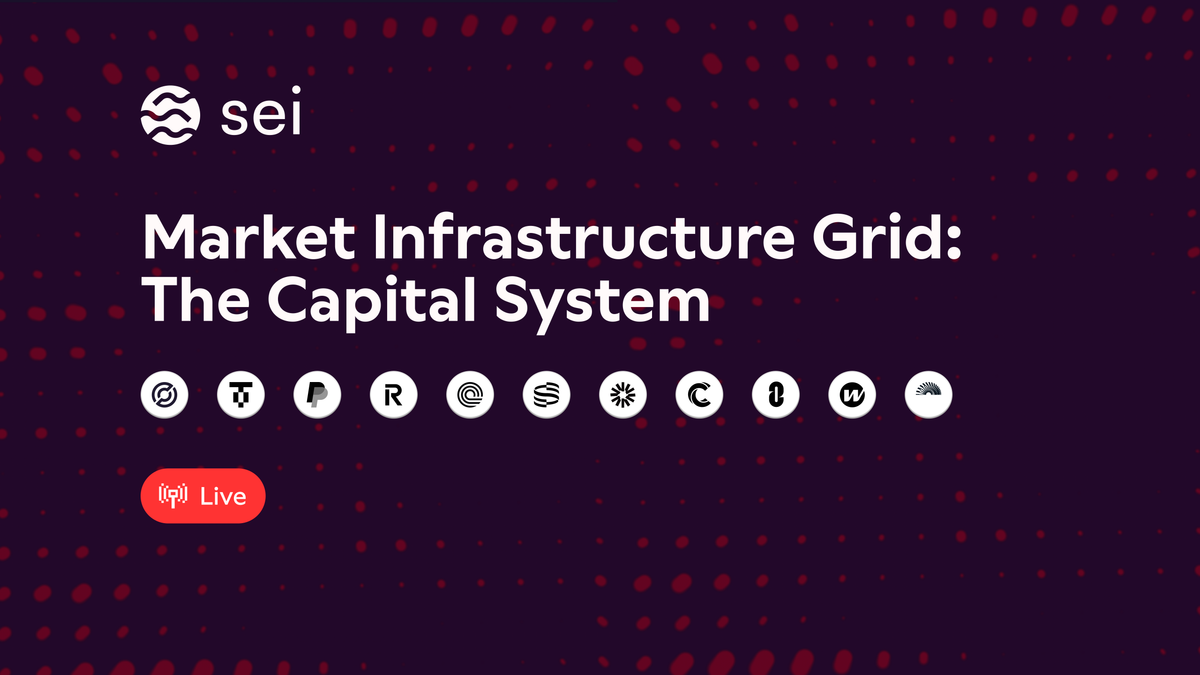
The Market Infrastructure Grid’s Capital System provides a clear map of this enterprise-grade capital infrastructure, making it legible for enterprises and institutions evaluating deployment.
What the Capital System Represents
The Capital System reflects the broad spectrum of capital infrastructure providers operating on Sei, mapping the providers that enable:
- Stable value and payments, supporting the global movement and settlement of capital
- Tokenization infrastructure, enabling real-world and digital assets to operate onchain
- Distribution and access, connecting capital to global users, applications, and platforms
- Cross-network settlement, ensuring capital remains liquid and accessible across global venues
Collectively, these providers form a capital infrastructure layer that supports enterprise-grade markets on Sei.
Stable Value and Payments
Stablecoins are a proven instrument for representing stable value onchain, supporting trading, payments, and treasury operations across global markets.
On Sei, a clear set of established stablecoin issuers and payment platforms operate on shared, real-time infrastructure, supporting enterprise and consumer use cases:
- Tether’s USDT0 brings the world’s most widely used stablecoin into an omnichain, composable form on Sei. USDT0 enables global liquidity and crosschain settlement.
- Circle delivers the leading regulated stablecoin, USDC, backed by institutional-grade compliance and transparency, and CCTP, enabling instant, seamless crosschain USDC settlement supporting secure payments, liquidity management, and treasury workflows at scale.
- PayPal, through its PYUSD0 stablecoin, connects consumer and merchant payment flows to onchain infrastructure.
- Revolut extends fintech distribution, enabling global access to Sei via digital asset markets.
Together, these providers form a credible stable value layer that has the power to support continuous capital activity on Sei.
Tokenization Infrastructure
Tokenization on Sei enables enterprises to use familiar financial instruments within programmable, always-on market environments, changing how capital can be deployed and managed.
By making traditional assets composable through tokenization, enterprises are able to move, redeploy, and integrate capital programmatically — rather than through fragmented custody, settlement, and reconciliation workflows.
Tokenization providers in the Capital System enable the direct integration of real-world financial instruments into onchain markets:
- Ondo offers tokenized treasury assets designed for onchain liquidity and programmability, soon enabling enterprises to access yield-bearing instruments on Sei via their flagship USDY.
- Securitize provides regulated issuance and lifecycle management for tokenized securities, offering direct onchain exposure to Apollo’s ACRED private credit fund.
- KAIO delivers tokenization infrastructure for traditional financial instruments, enabling native access to tokenized products from BlackRock, Laser Digital, and Brevan Howard.
Once enterprises enter the Sei ecosystem, these instruments are readily available to be traded, used as collateral, and settled continuously without leaving the execution environment.
Issuance, Offerings, and Distribution
To facilitate global capital formation, compliant primary issuance and distribution methods are essential. Onchain infrastructure enables enterprises to raise, distribute, and manage capital with increased speed, global accessibility, and programmatic control.
The Capital System maps infrastructure that supports IPO-style offerings, token sales, and compliant asset distribution:
- CoinList provides primary issuance, token sales, and regulated distribution infrastructure.
This growing vertical on Sei enables enterprises to access global participants directly within established compliance frameworks, without relying on fragmented intermediaries.
Cross-Network Capital and Settlement
Real capital efficiency requires a unified liquidity landscape rather than a fragmentation of isolated networks. Cross-network infrastructure ensures capital on Sei remains fluid, composable, and accessible across the broader onchain economy.
The Capital System maps the infrastructure maintaining connectivity between Sei and external networks while preserving performance and settlement guarantees:
- Wormhole supports high-throughput messaging and asset transfer across networks.
- LayerZero provides omnichain communication primitives for crosschain messaging or composable applications built by enterprises.
- deBridge enables efficient cross-network liquidity movement and settlement.
Together, these providers can enable enterprises to utilize Sei as a high-performance execution and settlement environment while retaining the flexibility to redeploy capital across the broader onchain economy—without fragmenting liquidity, increasing settlement risk, or sacrificing execution quality.
Why the Capital System Matters
Capital infrastructure becomes an advantage when it operates as a unified system.
On Sei, real-time execution and deterministic performance converge with a diverse set of capital infrastructure providers—spanning stable value, tokenization, and cross-network settlement—to create a frictionless environment where capital moves and settles in real time.
The Capital System of the Market Infrastructure Grid maps this environment into a clear operational view. It provides enterprises with a production-ready blueprint, enabling teams to bypass component assembly and move directly to deployment.
Sei is infrastructure for modern markets. The Grid is how enterprises and institutions plug in.