Developers’ Dilemma of Ethereum Gas Fees: How Sei Solves It
Table of Contents
- The Persistent Challenge of Ethereum Gas Fees
- Are Layer 2 Networks the Real Solution?
- Why Ethereum Developers are Moving to Sei
- How Sei v2 Redefines Cost-Effective Scalability
- The Future: Sei Giga and Limitless Scaling
- Conclusion: Building on Sei
- Frequently Asked Questions (FAQ)
EVM developers perform constant mental math to reduce gas consumption on Ethereum mainnet. These micro-optimizations often compromise the intent of writing clean and logical code.
To avoid this dilemma, developers turn to alternative scaling methods like rollups. However, these are often limited by complexity, centralization, and interoperability challenges. This frustration creates barriers related to unpredictable and often disproportionate Ethereum gas fees.
To find a workaround for high costs, developers are exploring high-performance Layer 1 alternatives like Sei.
Why Are Ethereum Gas Fees a Persistent Challenge?
The Ethereum mainnet has been the pioneer of smart contract platforms, but it's fundamentally limited by throughput. When demand exceeds supply, it drives up the gas fees. For example, in early 2024, an average token swap on Ethereum mainnet cost users around $86 in fees, where a simple NFT trade could burn $145 in gas.
These costs price out many users, making specific dApp use cases infeasible on Ethereum mainnet. With the Dencun update, which introduced data sharding for Layer 2 networks, the average fees dropped by 95%. The swap now costs around $0.39.
It was a significant improvement, but it relied heavily on offloading activity to Layer 2 networks.
Are Layer 2 Networks a Solution for Ethereum Scalability and Lower Gas?
Ethereum’s answer to its scalability problems has been the modular approach, which uses Layer 2 rollups and planned sharding of data. In this model, Layer 2 solutions, like Optimistic or ZK-Rollups, bundle many transactions off-chain and post minimal data on Ethereum mainnet, dramatically increasing throughput and lowering per-transaction cost.
However, while rollups alleviate the fee pressure, they introduce complexity and fragmentation from a developer’s perspective. Each rollup is effectively a new chain with its own sequencer, tooling quirks, and bridging requirements to move assets between layers.
For developers, this means additional overhead in deploying and managing contracts across multiple environments.
Layer 2 solutions act as a sub-optimal quick fix for scalability and gas fee issues. In a blog post on Cointelegraph, Sei’s co-founder Jay Jog shared his opinion:
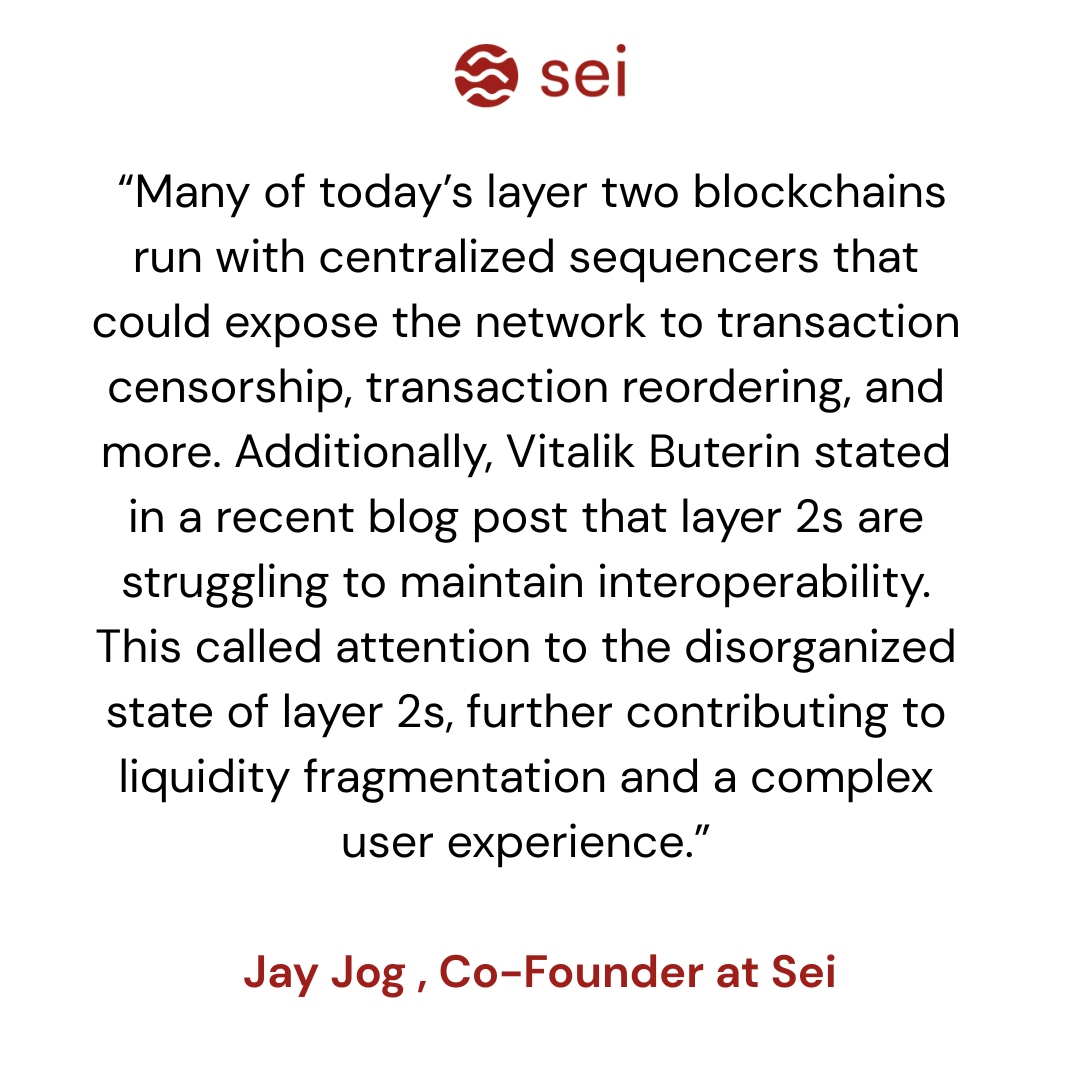
Although native rollups are trying to tackle Layer 2's centralization issues, they take value away from projects, which significantly deters adoption. With these challenges in place, why rely solely on Layer 2 networks without exploring alternatives? Instead of running more Layer 2 networks and interoperability solutions, why not refine the existing foundational Layer 1?
Based on community signals, this is what developers and users expect from a fix-all solution. New high-performance Layer 1 blockchains deliver a more straightforward solution to Ethereum mainnet scalability and gas costs.
In essence, the discussion boils down to the distinction between modular and monolithic scaling. Ethereum is moving toward a modular, multi-layer ecosystem to reach high throughput over time, whereas others believe a next-generation Layer 1 can directly offer high throughput without the added complexity.
Enter Sei. Layer 1 EVM blockchain that solves cost and scalability issues for Ethereum developers.
Why Ethereum-Native Developers Prefer Sei Over Other Options Like Solana?
Sei feels like the Ethereum mainnet without the heavy gas fees.
Sei offers the experience of the Ethereum mainnet without the heavy gas fees. It provides the same tools and sub-second finality on a Layer 1 that is fully EVM-compatible.
Other alternatives, such as Solana, would require developers to rewrite the code in Rust or use specialized frameworks like Anchor, making it harder for Ethereum-native teams to port their apps. Apart from these, several other factors make Sei a more preferred chain for EVM developers, including:
- Compatibility & Dependencies: For EVM developers, Sei offers a plug-and-play path. Alternatively, Solana would require a paradigm shift. Solana requires developers to manually declare state dependencies and access lists upfront for parallelization to work. In contrast, Sei’s model handles this dependency resolution automatically at the protocol level. This allows Ethereum developers to deploy existing contracts without rewriting code or managing complex state access logic.
- Gas fees volatility: Both Sei and Solana offer cheap gas fees. However, during congestion, gas fees tend to spike on Solana. Contrastingly, Sei delivers a more predictable gas model while scaling.
- Performance: Sei delivers sub-second finality with parallelized execution for DeFi and consumer-scale apps. Solana is also fast, but it has a monolithic architecture. It means all apps would compete for block space. One app's congestion might slow down the entire chain.
- Migration: Migration from Ethereum mainet to Sei has lower friction and familiar EVM tooling. However, in the case of Solana, migrating from Ethereum is challenging, as developers must be prepared to adopt Rust and navigate a completely different execution model.
Sei offers a better proposition in terms of scalability and lower gas costs. Sei v2 optimizes this further:
How Sei v2 Solves for High Gas Fees and Scalability
Sei v2 is designed to solve for cost-effective scalability. It delivers the first parallelized EVM with a hyper-optimized execution layer that benefits from tooling and mindshare of the EVM.
Sei v2 delivers various upgrades that enable high performance, along with a flexible environment that allows developers to work effectively. It changes how the execution layer works to support optimistic parallelization and optimized state storage.
Here are some of the key highlights of Sei v2:
Backwards Compatibility with Ethereum
Developers don’t need to rewrite their Ethereum contracts to deploy on Sei. Sei v2 offers full bytecode compatibility. Anything that runs on Ethereum’s Go implementation can run on Sei.
It allows developers to redeploy existing Ethereum mainnet contracts with zero code changes, giving a flexible way and encouraging adoption.
Optimistic Parallelization
Traditionally, blockchains process transactions sequentially, which limits throughput. Sei v2 changes this.
- Runs transactions in parallel: Sei automatically identifies independent transactions and multiple CPU cores process the non-conflicting ones simultaneously.
- Conflict resolution: If two transactions touch the same state, the chain reruns them sequentially while keeping others parallel.
- Applies to all transactions: Whether they’re EVM or Sei-native, parallelization increases throughput across the board.
This approach removes manual overhead for developers and delivers performance at the chain level.
Twin Turbo Consensus
Traditional Tendermint runs consensus steps one after the other. Sei changes this by pipelining and parallelizing these steps while tying them to its parallel execution engine. This is achieved through two distinct innovations:
- Intelligent Block Propagation: Sei block proposers send a compact proposal with transaction IDs and a reference to the full block, avoiding unnecessary waits. Validators locally rebuild the full block using existing mempool data and only request missing parts. This drastically cuts data wait times for validators, boosting network throughput.
- Optimistic Block Processing: Traditional blockchains process after "Precommit." Sei accelerates finality by processing transactions concurrently with "Prevote" and "Precommit." Validators optimistically cache the candidate state; if the block is accepted, the state is committed instantly. If rejected, the cache is discarded. This parallel processing drastically cuts time to finality.
This allows blocks to be executed and validated simultaneously, rather than waiting for one step to complete before the next begins.
The Twin Turbo consensus gives developers several advantages, including:
- Near-instant finality. Transactions are final in ~400 ms.
- Better UX. Interactions feel immediate, like in traditional applications.
- New use cases. For example, high-frequency trading onchain, real-time oracles for DeFi, and onchain games that need better responsiveness.
- Faster DeFi workflows. Multi-step operations like approve, swap, and stake settle in just over a second, improving capital efficiency.
Optimized State Storage with SeiDB
Sei re-architected its database layer for speed and efficiency. Its storage is divided into the state store and the state commitment. The former gives fast key-value access while the latter delivers an optimized consensus layer.
It reduces disk usage by storing historical data as raw key-value pairs, which eliminates redundant metadata and improves recovery.
Moving Toward A Hyper-Optimized Layer 1 for Limitless Scalability: Sei Giga
Sei Giga is the upcoming network upgrade after Sei V2. It’s set to deliver a throughput in the order of 5 gigagas per second with 400ms time-to-finality, making Sei the most preferred chain for scalability and cost-effectiveness.
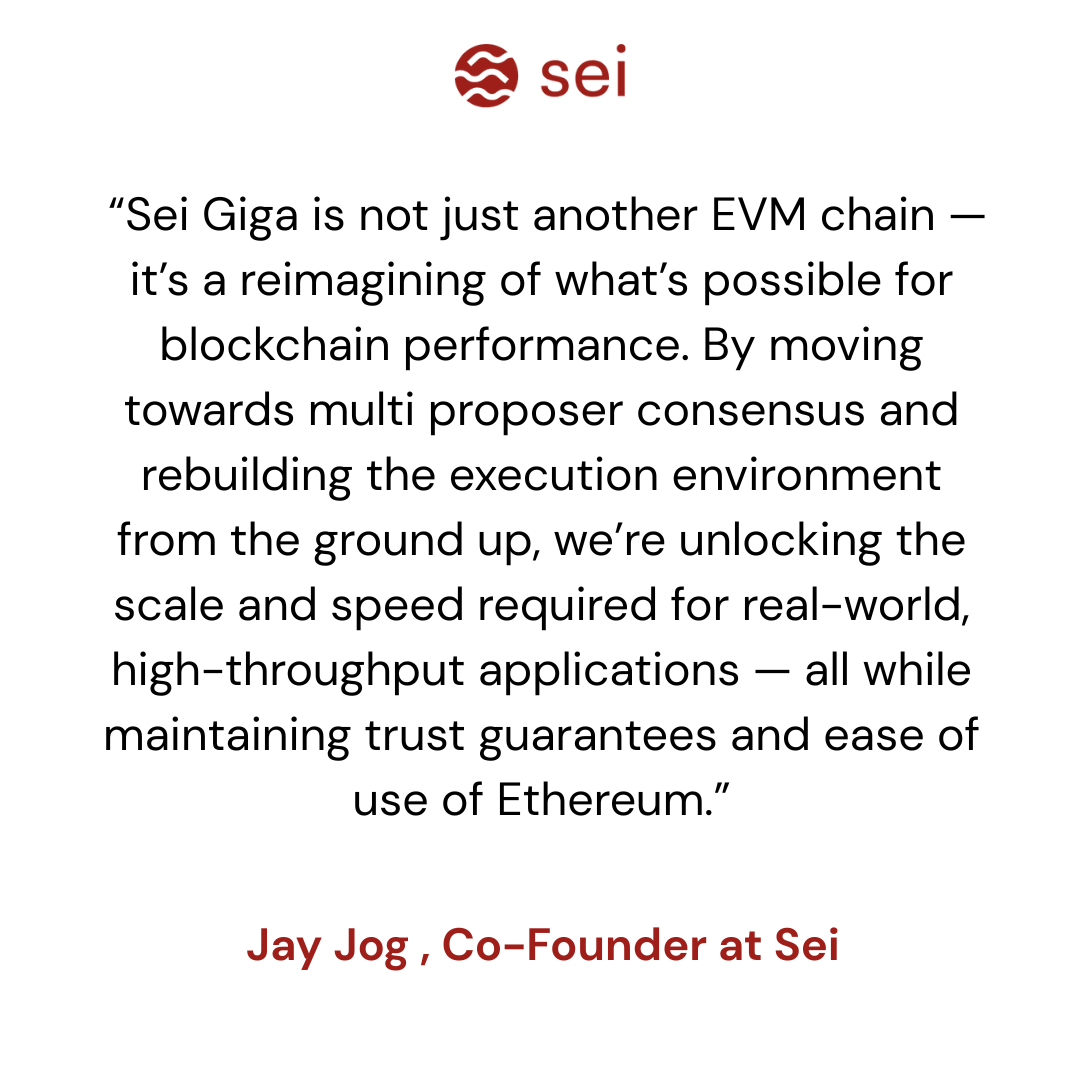
Sei Giga’s Whitepaper has been released, and it has some key features.
Sei Giga is built for speed and scale, processing up to 5 gigagas and around 200,000 transactions per second. Transactions are confirmed in under 400 milliseconds, giving users near-instant finality. It’s fully compatible with Ethereum smart contracts in Solidity and Vyper, allowing developers to migrate their applications easily.
In its consensus protocol, Sei introduces Autobahn consensus, which enables multiple block proposers to work in parallel, delivering up to 50 times higher throughput. Instead of relying on reth or geth, Sei Giga features a brand-new EVM execution client built from scratch to maximize efficiency. It also improves performance with asynchronous state commitments, generating them outside the critical consensus path to remove bottlenecks.
Build on Sei
Sei delivers the experience users crave. It enables developers to deploy a dApp where users don’t even notice gas fees, transactions confirm virtually instantly, and they no longer have to stress over network congestion.
The Sei network empowers developers to build high-frequency apps that settle in 400ms and process 10,000 transactions for as low as $0.05. Most importantly, it enables this magnitude of performance while being a layer 1 blockchain network.
Sei delivers the scalability developers need while keeping the transaction costs low. With the Sei Giga upgrade, network performance will increase even further, while still ensuring 100% compatibility with EVM.
Build for the future.
Get started with Sei and learn more about the ecosystem.
FAQ
What are Ethereum gas fees?
Gas fees are payments made by users to compensate for the computing energy required to process and validate transactions on the Ethereum blockchain.
How does Sei reduce gas fees compared to Ethereum?
Sei uses parallelized execution and the Twin Turbo consensus to process thousands of transactions simultaneously. This high throughput prevents the network congestion that typically drives up fees on the Ethereum mainnet.
Is Sei compatible with Ethereum smart contracts?
Yes. Sei v2 is fully bytecode compatible with the EVM (Ethereum Virtual Machine). This means developers can deploy Solidity or Vyper contracts from Ethereum to Sei without changing any code.
How fast are transactions on Sei?
Sei offers sub-second finality, with transactions typically confirming in approximately 400 milliseconds.
What is the difference between Sei and Solana for EVM developers?
Solana requires developers to learn Rust and manage complex state access logic. Sei allows EVM developers to use their existing Solidity skills and tools (like Hardhat or Foundry) while offering performance similar to or better than Solana.
Disclaimer:
This post is provided for informational purposes only and does not constitute an offer to sell or a solicitation of an offer to buy any securities, digital assets, or investment products. Any forward-looking statements, projections, or descriptions of anticipated activities are subject to risks and uncertainties and may not reflect actual future outcomes. Sei Development Foundation is not offering or promoting any investment in SEI tokens or digital assets, and any references to token-related activity are subject to applicable U.S. securities laws and regulations. All activities described herein are contingent upon ongoing legal review, regulatory compliance, and appropriate corporate governance. This post should not be relied upon as legal, tax, or investment advice.