
Giga Manifesto
Finance is moving onchain. With Giga, Sei is purpose-built for what's next.
Why tokenized markets need Giga
Since Sei's inception, the premise has been clear: an internet-native financial system needs internet-native financial rails.
The original Sei whitepaper, published by Sei Labs, made the case directly: "The need to exchange digital assets is fundamental to every aspect of crypto, from social applications to non-fungible tokens and gaming." In 2023, Sei was introduced as the Layer 1 for Trading.
At the time, that described a small economy, the one operating inside crypto, where every meaningful action was, fundamentally, a trade.
The onchain economy is now broadening to include traditional finance, led by tokenized equities and commodities.
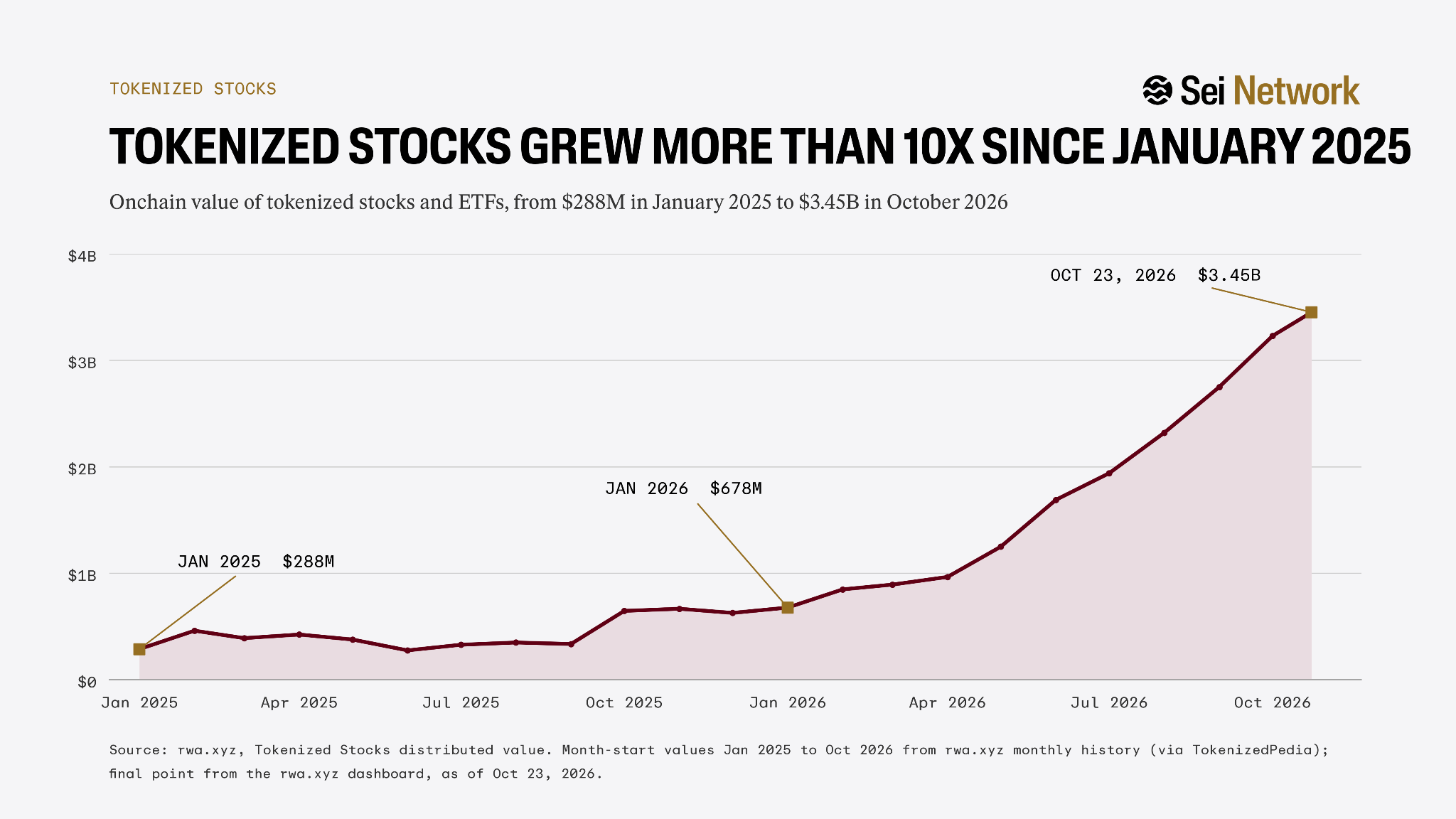
The transition has already begun. Equities started arriving onchain in 2025 and became permissionless in 2026. Treasuries, money market funds and private credit are following, issued as tokens by some of the world's largest asset managers.
Assets like these need real markets to trade in, and for most of crypto's history, the infrastructure could not support them.
Early blockchains could not process orders, cancellations and price updates at the speed an institutional exchange requires. That ruled out the possibility of central limit order books, the price-time priority matching model that stock exchanges use, so builders turned to automated market makers. Pools made it simple to launch a token, seed liquidity and establish a price, but they deploy capital far less efficiently than an order book.
The result was that serious assets saw little onchain trading, and activity concentrated in memecoins. Giga brings order books onchain, giving tokenized stocks the market infrastructure they require.
Tokenized assets follow the same market mechanics as any other asset. Stocks, Treasuries and currencies trade in deep markets offchain, but their tokens arrive onchain without that liquidity, so it has to be bootstrapped. Early on, thin books mean wide spreads and large margins for whoever supplies liquidity, and those margins narrow as the market matures. Liquidity settles where the venue is best: capital-efficient order books, predictable execution, and fills at the expected price.
Issuance is the easy part. What tokenized assets need next is a venue where orders execute on time and cancellations land in time, even when trading spikes.
Giga rebuilds Sei from the ground up to bring Nasdaq-grade markets onchain.
For anyone trading on Sei, that means four things. No single validator can block a trade. Large orders are protected. Execution is fast enough to keep tokenized stocks in step with the stock market. And the network has the capacity to run full order books onchain. The final sections cover Giga's path to mainnet and why tokenized markets are building on Sei.
Giga keeps any single validator from blocking your trades
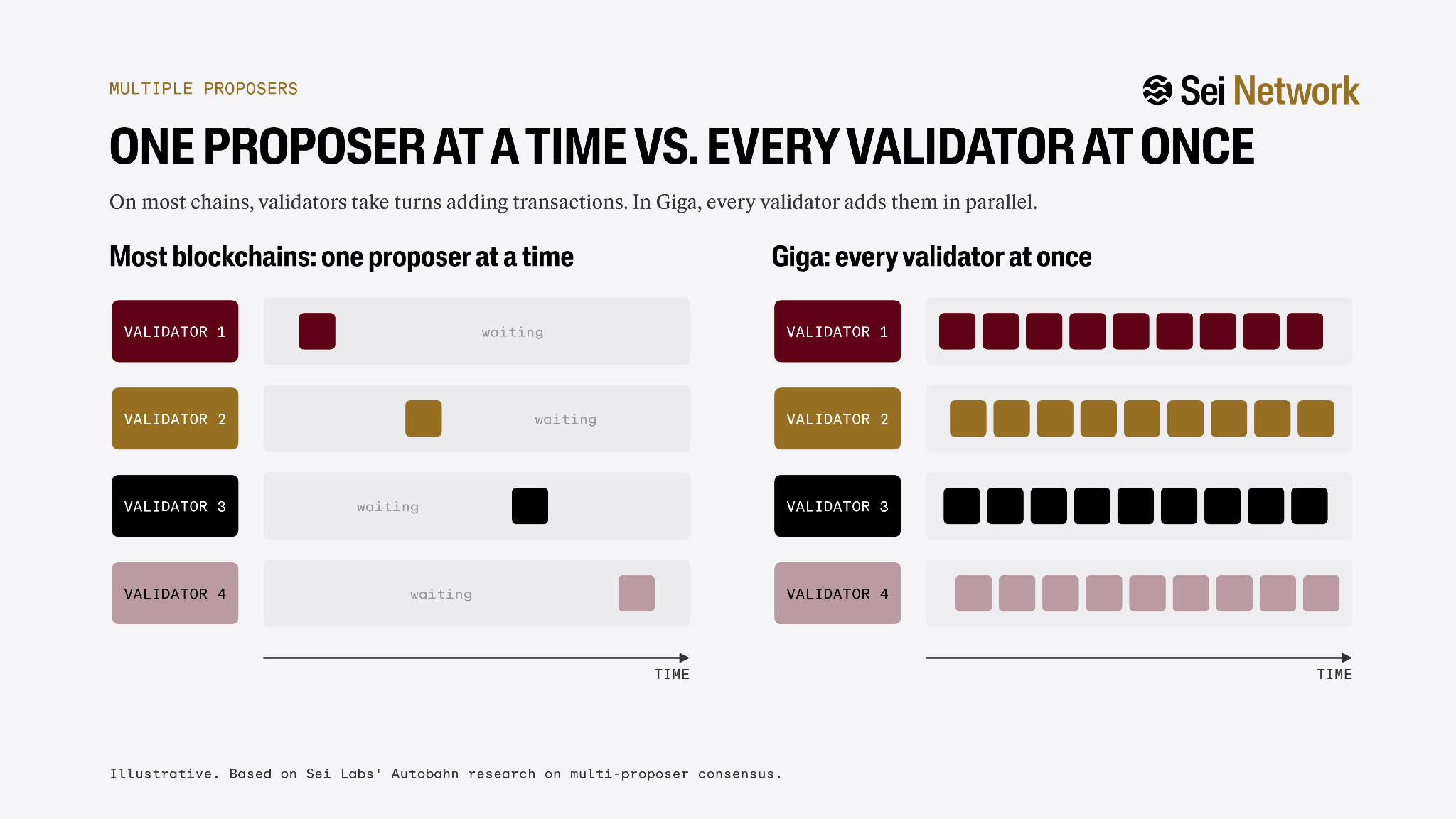
On most blockchains, one validator at a time decides which transactions go into the next block while the rest of the network waits. That validator can delay a transaction or leave it out, and the trader has little recourse.
In Giga, every validator proposes transactions at the same time. A trader can send the same transaction to many validators at once, so no single validator can keep it out. To block it, every validator it reached would have to ignore it.
The difference is easiest to see side by side. On a single-proposer chain, validators take turns, and only one of them can add transactions at any given moment. In Giga, every validator adds transactions continuously, all at once.
For sophisticated traders, this is the guarantee that matters most. A market maker quoting tokenized stocks needs to know that when it cancels an order, the cancellation goes in.
Consider a hypothetical example. Say a market maker is offering to sell 1,000 shares of a tokenized Nasdaq-listed stock at $100. News breaks, and the stock jumps to $105 on Nasdaq. The market maker sends a cancellation.If a validator ignores it and the stale order is filled, the market maker has sold $105,000 worth of stock for $100,000, a $5,000 loss on a single order. Across a full book of quotes during a volatile session, that risk adds up quickly. With multiple proposers, the cancellation reaches the network through many validators at once, and no single one can hold it back.
Giga also agrees on the order of transactions first and processes them afterward, off the critical path. For a trader, that ordering is the moment that matters: once a transaction's place in line is final, its result follows deterministically.
Giga protects large orders
Nearly every blockchain has MEV, the profit taken by whoever controls transaction order, usually by trading ahead of a visible order. Most networks tolerate it. The cost is worse prices for retail traders, and it is a major reason large institutional orders have stayed off public chains.
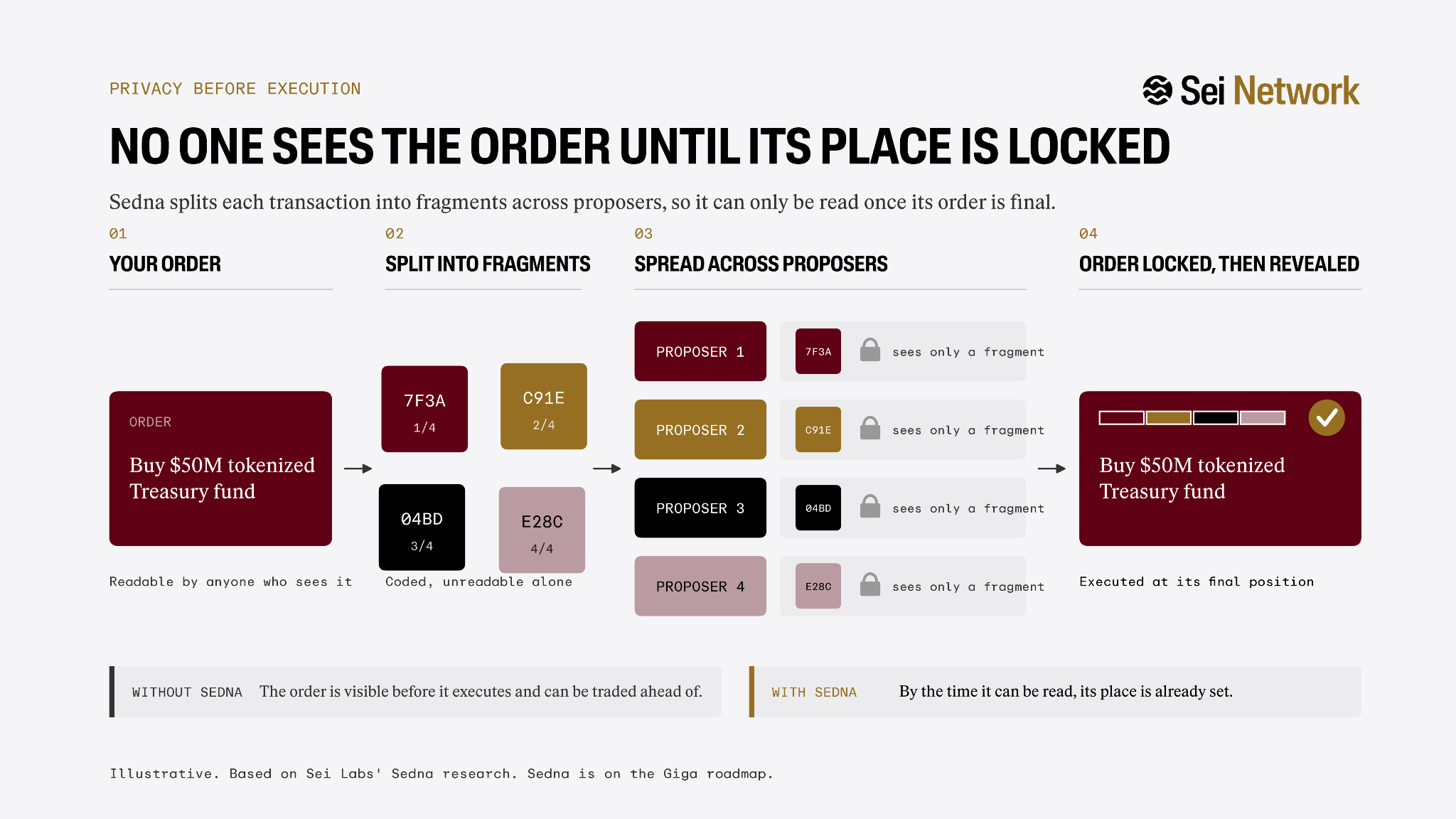
Giga tackles it at two levels. With every validator proposing in parallel, no single proposer controls the order, which removes the most common forms of MEV. Sedna, a privacy layer on the Giga roadmap, is designed to remove the rest. It keeps each transaction private before it executes by splitting it into coded fragments across proposers, so no one can read it until its place in line is final.
Say a fund is buying $50 million of a tokenized Treasury fund. Without that protection, a fast trader can see the order and buy first. With Sedna, by the time the order can be read, its position is already set.
Giga is fast enough to keep tokenized stocks in step with the stock market
A tokenized stock has to track the price of the real stock on its primary listing exchange. When that price moves, the onchain market has to catch up, and every moment of delay is a window in which the two prices disagree. The faster transactions become final, the smaller that gap.
That matters more for tokenized stocks than for most crypto assets. A memecoin has no outside market it needs to match. A tokenized share of a listed company does, and it trades around real-world events: rate decisions, earnings, market opens.
Speed also has to hold when it counts. Average speed is easy to advertise. Markets are tested in the tail, when a leader stalls or volume spikes. A cancellation that lands late in a volatile minute becomes a fill at the wrong price.
Giga reaches speed in two stages. At launch, Giga runs on Autobahn, its multi-proposer consensus, which has been tested at finality under 250ms. Sei will then upgrade to Hermes, a faster consensus protocol already on the Giga roadmap.
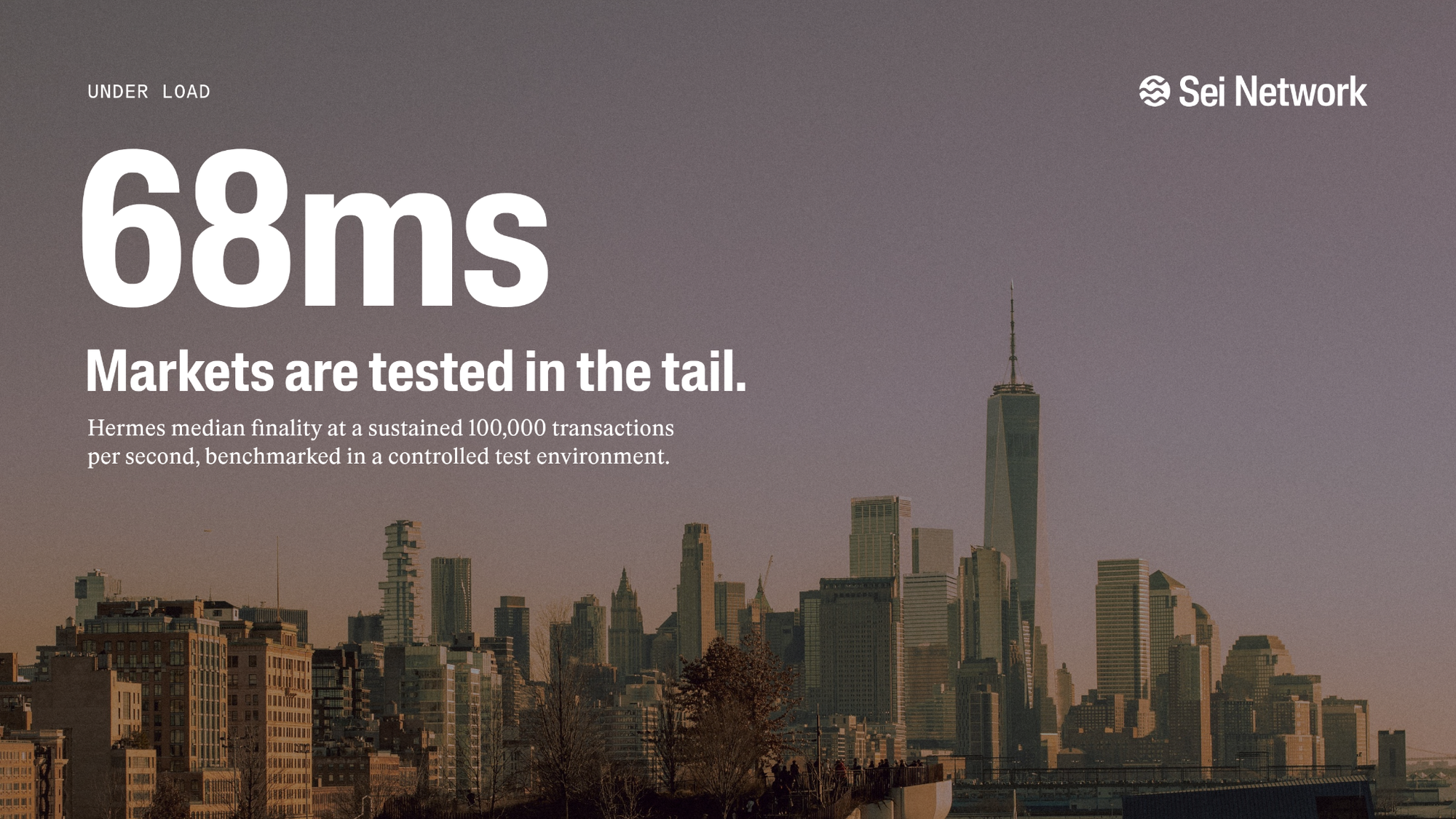
In Sei Labs benchmarks at a sustained 100,000 transactions per second, Hermes reached median finality of 68ms, with 95% of transactions final within 101ms. With three consecutive leaders stalled, it held 95th-percentile finality at 206ms, while the other protocols in the same test landed between 365ms and 664ms.
Giga has the capacity to run order books onchain
A stock exchange handles an enormous stream of orders, cancellations and price updates every second, at volumes today's blockchains were not built for. Most chains share the bottleneck described above: one validator at a time builds each block, so the whole network moves at the pace of a single proposer.
Giga removes that bottleneck. Because every validator proposes in parallel, capacity grows with the number of proposers. The intuition is simple: if one proposer is the limit, 40 proposers working at once open roughly 40 times as many lanes for transactions.
The Giga whitepaper targets more than 200,000 transactions per second, or 5 gigagas per second, with finality under 250ms across a decentralized validator set.
That capacity is what makes central limit order books practical onchain. Tokenized stocks need them because they attract sophisticated traders who quote tightly, cancel often and trade in size. Memecoin markets are largely retail and can run on AMMs. Markets for stocks need order books, and as more of the world's assets are tokenized, the venue they trade on has to scale with them.
How Giga reaches mainnet
Issuers and institutions already live on Sei will not have to migrate to get the upgrade. Giga is arriving as upgrades to the live network.
Sei v6.6 brought Giga's first execution and storage components, Ares and Eidos, to mainnet on August 4, with no regenesis and no new chain. Upgrades to execution and storage will continue in subsequent releases, followed by the upgraded consensus layer, which will run first on a Giga testnet before reaching mainnet.
The roadmap is public, and each milestone can be checked as it ships.
Why tokenized markets will trade on Sei
Sei was built for one thing from the start: trading. More than $15.9B has traded on Sei DEXs since launch.
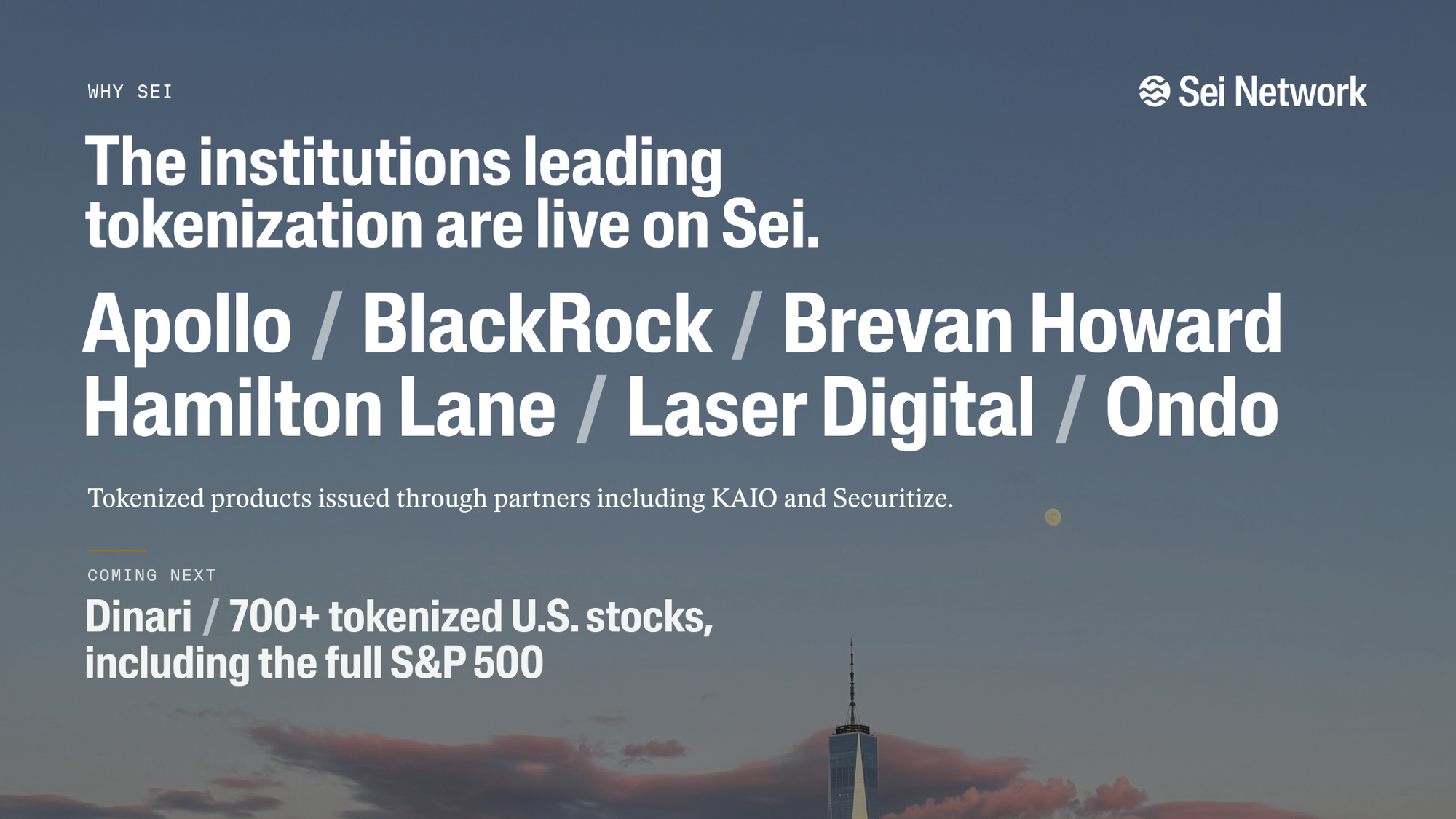
That focus has drawn the institutions leading tokenization. Apollo, BlackRock, Brevan Howard, Hamilton Lane, Laser Digital and Ondo all have tokenized products live on Sei, issued through partners including KAIO and Securitize. Tokenized stocks are coming next: Dinari is bringing more than 700 tokenized U.S. stocks to Sei, including the entire S&P 500, as dShares, backed 1:1 by securities held by a registered U.S. broker-dealer and available to eligible U.S. investors. Mastercard and Sei have published joint research on how banks and asset managers take blockchain from pilot to production.
The assets are arriving. Giga is how Sei becomes the market they trade on, with fair ordering, finality that holds under load, protection for large orders, and capacity for global scale, delivered to the network those assets already live on.
The future of financial markets is onchain.
Sei is the blockchain for trading.