How institutions actually adopt blockchain: new research with Mastercard A joint report from Mastercard and the Sei Development Foundation on how financial institutions evaluate blockchain infrastructure and take it to production.
The Eidos Upgrade: replacing Sei’s storage database while the chain is running TL;DR: Every blockchain node has two jobs: compute what happens next on the chain, and store what has already happened. Storage is a critical bottleneck for all blockchains as they attempt to scale. If storage can't keep pace with the rate at which new transactions are executing,
Ares and Eidos, the first components of the Giga Upgrade, will go live in Sei 6.6 TL;DR: the proposal for Sei 6.6 is live, and it will be the release where Sei Giga starts touching mainnet. 6.6 will introduce the first pieces of two of the three major Giga upgrades: Eidos, a new storage layer that will begin moving the chain’s history
Keeping the Sei Network safe from quantum computers TL;DR: Sei Labs has shared a new proposal, SIP-5, that lays out how existing accounts can stay safe once quantum computers are powerful enough to break today’s cryptography. The plan lets users keep current addresses and balances, allowing you to add a quantum-resistant key when you
Sei Labs Publishes the Giga Whitepaper V2 The Sei Giga Whitepaper V2 is a major update to the original Giga Whitepaper published in May 2025. It introduces significant performance improvements and new features to Sei Giga, redesigning Sei Network from first principles into a blockchain with the ideal architecture for onchain trading. Read the full whitepaper at:
What SIP-03 means for exchanges and custodians There four upgrade paths for exchanges and SEI token custodians. This integration must be completed by June 15, 2026, prior to Cosmos deprecation
Autobahn: Sei Giga's Multi-Proposer Approach to Blockchain Consensus Introduction Unlike earlier PoS designs, Tendermint offered deterministic guarantees for consensus and eliminated the possibility of forks, which became a very influential model for modern PoS blockchains. However it still faces throughput limitations due to its single-proposer architecture. Sei Giga is using the Autobahn consensus mechanism, which is based
Building the Robot Economy: DePIN Tokenization as Capital Formation for Embodied AI From unimodal to multimodal LLMs LLMs evolved from unimodal systems that process single data types (e.g., text) to multimodal systems capable of understanding and generating diverse modalities such as text, images, audio, video, and more. The introduction of transformer architecture in 2017 marked a pivotal moment in the history
Proof of AI Agent will become even more critical than Proof of Humanity When we last discussed the emergence of the next billion agents, we outlined an architectural framework to support this coming wave. Soon, individuals won’t just have one AI agent but an entire army of them, executing tasks on their behalf. AI systems now outperform specialized human experts, with models
How Application-Specific Ordering Redistributes MEV Introduction Blockchain transaction ordering is a complex, high-stakes process. Block producers don't simply list transactions in the order they appear; instead, they solve a problem similar to the knapsack problem, selecting the mix of transactions that maximizes fee revenue while staying within block size or gas limits.
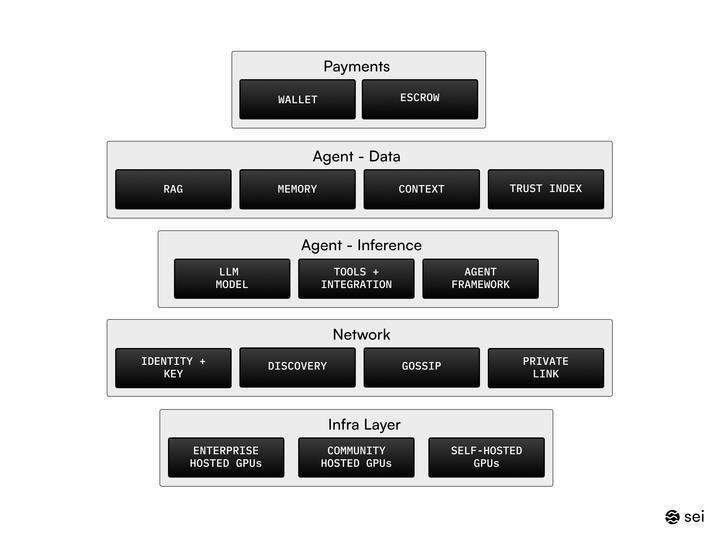
Collaborative Intelligence: Performant Blockchains Powering Private, Democratically-Governed AI Federated Learning (FL) and blockchain technology are emerging as a powerful combination for building decentralized AI systems. In FL, multiple devices or organizations collaboratively train an AI model without sharing their raw data, preserving privacy. A blockchain can provide a tamper-proof, decentralized infrastructure to coordinate this training and govern
AI: The Monetization Layer of Blockchain – Onboarding the Next Billion-Agents The Next Billion Users: AI Agents, Not Humans It seems that every week there’s a new major announcement in AI. We’re clearly standing at the threshold of something quite profound, something at least as profound as the internet has been. Another shift in digital interactions. The next billion
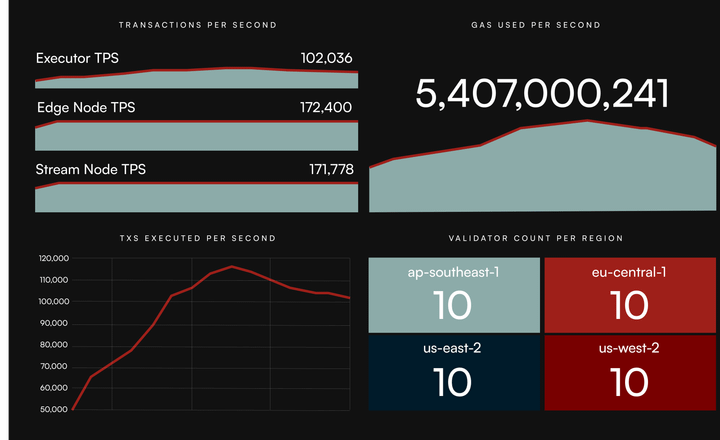
Sei Giga: Achieving 5 Gigagas with Autobahn Consensus The Sei Labs team were able to get 5 gigagas throughput in a 40-node network distributed across 4 regions in an internal devnet. This is a significant step forward in our mission to scale blockchain infrastructure for the next billion users. This post is the first in a series